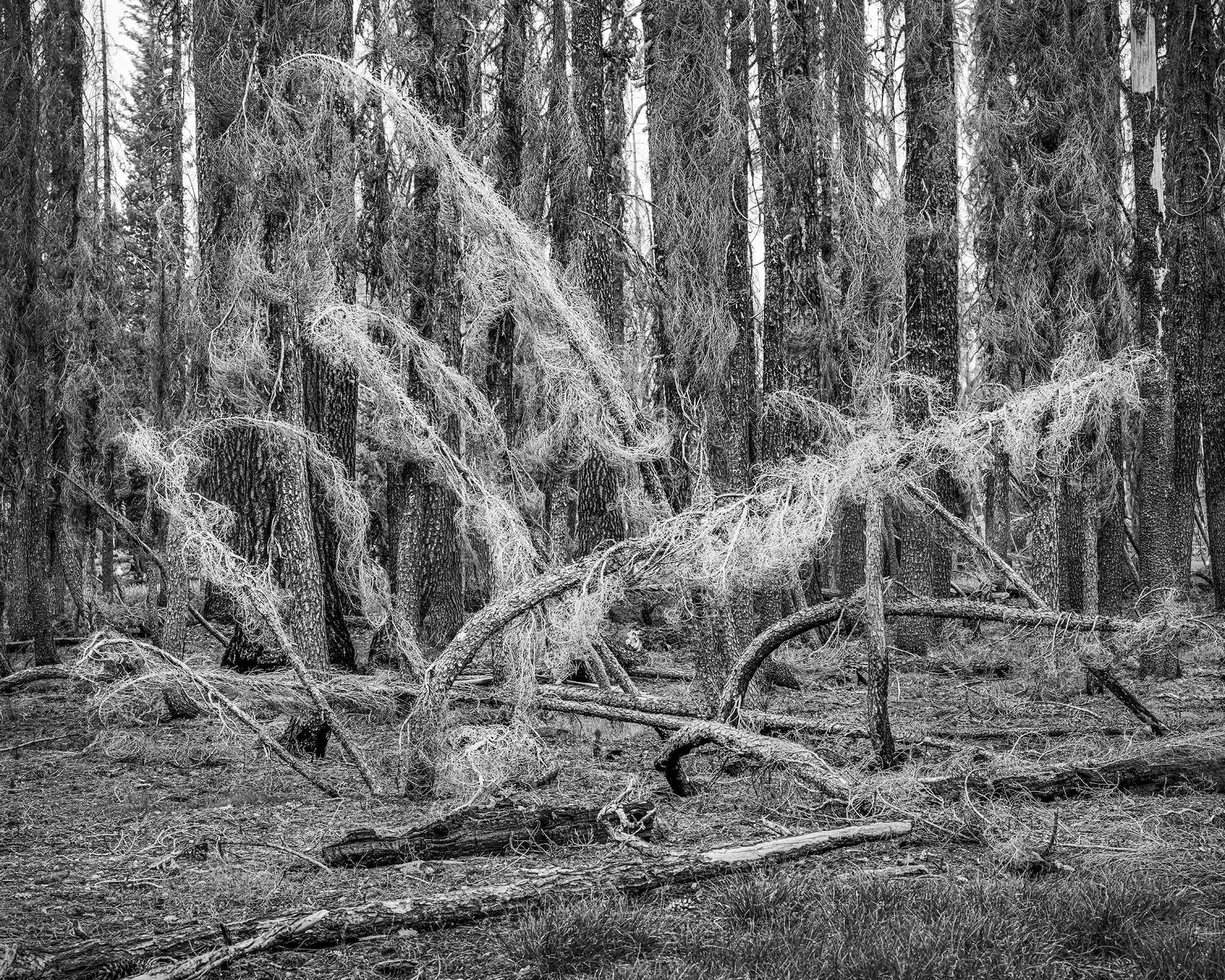
After
I arrived after. I wasn’t even aware there was an ‘after’ to which I would arrive. Had I heard, I don’t recall; it has all become commonplace. I recall the Camp Fire and its decimation of the community of Paradise but three years later the Dixie Fire, the single largest wildfire in California history at that time, wasn’t the same epicenter of attention or possibly that is what my mind wants me to recall. It’s easier on the mind to not accept the idea that one has become numb to such occurrences.
I arrived—unaware—four years after the fire that erupted, burned and smoldered for three and a half months. I did not see the flames or the smoke. I never once smelled the ash. I witnessed none of the sound, a deafening furnace, a staccato of snapping limbs, giving way to the silence of falling ash. Yet the ground still whispers what happened here. With each step along the trail, the finest dust rises softly, quietly—an echo of what once raged.
When I finally arrived and witnessed the landscape, I fell silent, muffled by shame, sorrow and disbelief. I have visited areas that lay victim to fire before, more often ones of the controlled essence in an attempt to prevent what this landscape endured. This was on a scale that was supremely different, its remains are supremely different.
In the past I never responded photographically to burn areas but as I realize that I may have fewer frames remaining than those already exposed, I felt a burning need to capture what I felt. Is there a growing respect for the end as one moves closer to it? I marveled at the vastness of what “was” only in my imagination and was drawn to portray what “is”. In these settings some may find inspiration and subjects to capture in the freshness of vibrant colorful growth on the forest floors. I was drawn to the monochromatic tones of those that were sacrificed.
Did they scream out? Did they feel? Or is that an illusion I cast on nature to veil the pain she must feel in our ongoing coexistence? I understood the fully burned trees, shining in the rich onyx tones—their fate was clear. Then there were those without a hint of burn, but were bent, twisted and sucked of any color they once held by the heat of the inferno. They are petrified sculptures of the story. But it was the limbs that affected me the greatest. At times they spiraled around their trunks, leafless and bone-like, as if attempting to shield their own souls. They lay scattered in arcs and angles, fallen in sacrifice so that new growth might one day rise from the forest floor. Though I know the science behind the state of their forms, these were the remains that challenged my mind to comprehend, and my soul to accept.
There are those that note the need for fire in the wild landscape as a means of clearing the old and nourishing the new. Fire is indeed an ingredient in the health of our forests. But where I struggle is in the cause. The natural world manages its own cycles, most often through lightning and, rarely volcanic events. Today, however, such natural ignition accounts for only about ten percent of these “necessary” fires. The remaining ninety percent are sparked by man.
Our natural world has proven remarkably resilient. I am drawn to the beauty born of that endurance—whether in a tree stretching skyward for thousands of years or in a valley shaped millions of years ago. To photograph such elements is my way of expressing gratitude for its enduring beauty and my hope that others may gain a deeper respect for our shared home.
Standing in the aftermath at Lassen National Park, I found myself thinking of Shel Silverstein’s The Giving Tree—the poem of a tree that offered everything it had to a boy from childhood through old age, leaving only a stump for him to rest upon. Interpretations vary, as they do with all art, but I could not help seeing the tree’s resilience as a symbol for our natural world. Resilience is not infinite. And I cannot help but wonder what stump, if any, will be left for us when nature’s endurance is finally spent.